
In Java, there are two ways of argument passing.
- Call by value
- Call by reference
Call by value
Whenever we call a method and passes the value of the variable to the called method, it’s called call by value.
class Demo {

    void set(int i, int j) {
        i = i * 2;
        j = j / 2;
    }
}

public class Test {

    public static void main(String arg[]) {
        Demo obj = new Demo();
        int a = 15, b = 20;

        System.out.println("Before call a=" + a + "  b=" + b);
		obj.set(a, b);
       System.out.println("After call a="+a+" "+" b="+b);
    }
}
Result
Before call a=15  b=20
After call a=15  b=20
Note: After multiplication and division value of a and b remain unchanged.
Explanation : In the above program, we are passing the value of a and b 15 & 20 respectively and set the value of i and j. After setting the value of i and j value of variable a and b remain unchanged because modifications occurs in variable i and j.
Call by reference
Whenever we call a method and passes the reference of the variable to the called method, it’s called call by reference.
class Demo {

    int a, b;

    Demo(int i, int j) {
        a = i;
        b = j;
    }

    void set(Demo o) {
        o.a = o.a * 2;
        o.b = o.b / 2;
    }
}

public class Test{

    public static void main(String arg[]) {
        Demo obj = new Demo(10, 20);		// passing value
        System.out.println("Before call a=" + obj.a + "  b=" + obj.b);
        obj1.set(obj);	//pass object obj1 as argument
        System.out.println("After call  a=" + obj.a + "  b=" + obj.b);
    }
}
Before call a=10  b=20
After call  a=20  b=10
Explanation: In the above program, in
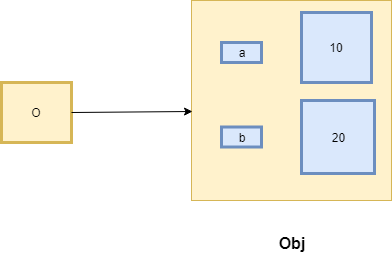
In the above figure
And when “obj.set(obj);” will execute it will pass object obj and reference of class Demo “o”