
Square root is one of the most useful topics in basic mathematics. It is connected with squares, area, exponents, algebra, geometry, mensuration, approximation, and many aptitude questions. If you understand what a square means, then square root becomes easy because square root is the reverse process of squaring.
When a number is multiplied by itself, the result is called the square of that number. For example, 6 × 6 = 36, so 36 is the square of 6. Now if we ask which number gives 36 when multiplied by itself, the answer is 6. Therefore, the square root of 36 is 6.
This article explains square root and cube root in simple language. The existing examples and images are kept in this post, and new explanations, tables, methods, solved examples, tricks, decimal cases, long division ideas, and practice questions are added to make the topic easier for students.
What Is Square Root?
The square root of a number is a value which gives the original number when multiplied by itself. If x × x = y, then x is the square root of y. We write this as √y = x.
Example: 8 × 8 = 64, so √64 = 8.
Example: 11 × 11 = 121, so √121 = 11.
Example: 15 × 15 = 225, so √225 = 15.
The square root symbol is called the radical sign. The number written inside the radical sign is called the radicand. In √49, the radical sign is √ and the radicand is 49.
Square and Square Root Relation
Square and square root are opposite operations. Squaring takes a number to its square. Square root brings the square back to the original number.
| Number | Square | Square root statement |
|---|---|---|
| 2 | 2² = 4 | √4 = 2 |
| 3 | 3² = 9 | √9 = 3 |
| 4 | 4² = 16 | √16 = 4 |
| 5 | 5² = 25 | √25 = 5 |
| 10 | 10² = 100 | √100 = 10 |
This relation is the first thing to remember. If you know squares of numbers, you can quickly find many square roots.
Perfect Squares
A perfect square is a number that is obtained by multiplying an integer by itself. For example, 36 is a perfect square because 6 × 6 = 36. Similarly, 49, 64, 81, and 100 are perfect squares.
| Number | Perfect square |
|---|---|
| 1 | 1 |
| 2 | 4 |
| 3 | 9 |
| 4 | 16 |
| 5 | 25 |
| 6 | 36 |
| 7 | 49 |
| 8 | 64 |
| 9 | 81 |
| 10 | 100 |
| 11 | 121 |
| 12 | 144 |
| 13 | 169 |
| 14 | 196 |
| 15 | 225 |
If a number is not a perfect square, its square root is not a whole number. For example, √2, √3, √5, and √10 are not whole numbers. These values are irrational numbers because their decimal expansion does not end and does not repeat.
Important Points About Square Roots
- The square root of 0 is 0.
- The square root of 1 is 1.
- The square root of a positive perfect square is a whole number.
- The square root of a positive non-perfect square is an irrational number.
- In real numbers, the square root of a negative number is not defined.
- Every positive number has two square roots, one positive and one negative, but √x usually means the principal positive square root.
Example: The square roots of 25 are 5 and -5 because 5 × 5 = 25 and (-5) × (-5) = 25. But √25 is normally written as 5 because the radical symbol gives the principal square root.
Existing Explanation and Examples
Square root
If you have to find square of a number then we write

it means we multiplied x two times and got y.
For example find the square of 2 that you have to multiple 2 two times

We find square of a number by multiplying that number twice.
So what is a square root
Finding a square root is reverse process of square.
In square root we find the number which is multiplied itself to get the square of number.
a square root is represented by symbol

This symbol is known as square root.
here x represents the number whose square root we want to find
In general
if then ,
,

in above example
Square root of y is x
square root of 4 is 2
square root of 9 is 3
Example find the value of 
We all know 36 is square of 6
so we can write 
so =
Find the 
 \sqrt{9*9}=9
Finde the square root of 625
by factoring 625
we get 625=5*5*5*5
so 
=
=5*5
=25
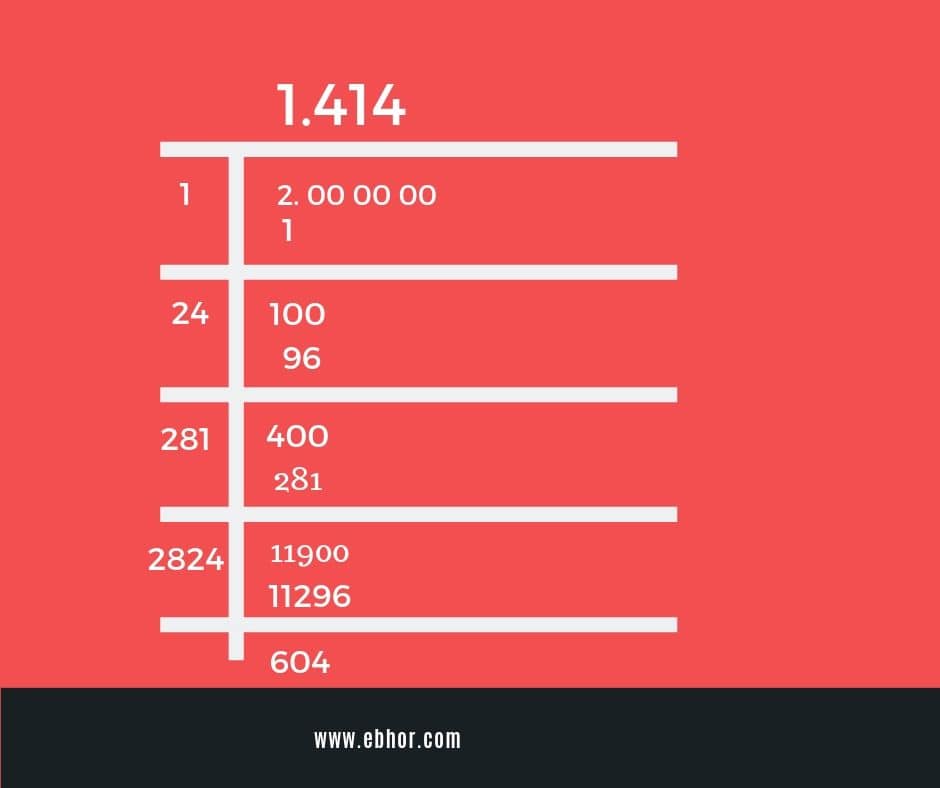
To find the square root of 2 is as below
Cube root
We can find cube of a number by multiplying it three times
for example to find cube root of x we multiply it tree times

Here y is cube of x
Finding the cube of 2
that is

here 8 is cube of 2
similar


Now what is cube root
Cube root is a reverse process of a cube.
In cube root we find the number which is multiplied itself thrice to get the cube of number.
![\sqrt[3]{x}=y](https://www.ebhor.com/wp-content/ql-cache/quicklatex.com-91ca70e532bfa2b81f32b0c2a147f825_l3.png "Rendered by QuickLaTeX.com") here
here ![\sqrt[3]{x}](https://www.ebhor.com/wp-content/ql-cache/quicklatex.com-cb7fb8f38dd8713241a6275d0f0969bd_l3.png "Rendered by QuickLaTeX.com") is known as cube root of
is known as cube root of 
Cube root is represented by
![\sqrt[3]{8}=\sqrt{(2*2*2)}=2](https://www.ebhor.com/wp-content/ql-cache/quicklatex.com-4d86cba3ed673d4e6d5a8aeb7d9a324c_l3.png "Rendered by QuickLaTeX.com")
![\sqrt[3]{x+y}](https://www.ebhor.com/wp-content/ql-cache/quicklatex.com-5b06c34877741c7593b64ba02f337cd7_l3.png "Rendered by QuickLaTeX.com")
here x is number whose cube root we want to fine
Finding Square & cube root by factorization
Find th square root of 6084

Calculate the value of 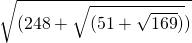
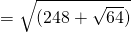
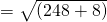
 169 is square of 13


Methods to Find Square Root
1. Square Table Method
This is the easiest method for small numbers. If you remember the square table, you can directly identify the square root.
Example: Find √144.
We know 12² = 144.
So, √144 = 12.
Example: Find √225.
We know 15² = 225.
So, √225 = 15.
2. Prime Factorization Method
Prime factorization is useful when the number is a perfect square. First write the number as a product of prime factors. Then make pairs of equal factors. Take one factor from each pair and multiply them.
Example: Find √576 by prime factorization.
576 = 2 × 2 × 2 × 2 × 2 × 2 × 3 × 3.
Make pairs: (2 × 2), (2 × 2), (2 × 2), (3 × 3).
Take one number from each pair: 2 × 2 × 2 × 3 = 24.
So, √576 = 24.
Example: Find √7056.
7056 = 2 × 2 × 2 × 2 × 3 × 3 × 7 × 7.
Taking one factor from each pair gives 2 × 2 × 3 × 7 = 84.
So, √7056 = 84.
3. Repeated Subtraction Method
The sum of first n odd natural numbers is n². This idea can be used to find square root of small perfect squares. Subtract consecutive odd numbers from the given number until the result becomes zero. The number of steps is the square root.
Example: Find √25.
25 – 1 = 24
24 – 3 = 21
21 – 5 = 16
16 – 7 = 9
9 – 9 = 0
There are 5 subtraction steps, so √25 = 5.
4. Estimation Method
Estimation is useful when the number is not a perfect square. First find the two perfect squares between which the number lies.
Example: Estimate √50.
49 < 50 < 64.
√49 = 7 and √64 = 8.
So, √50 lies between 7 and 8. Since 50 is very close to 49, √50 is a little more than 7. Its approximate value is 7.07.
Example: Estimate √90.
81 < 90 < 100.
√81 = 9 and √100 = 10.
So, √90 lies between 9 and 10. Its approximate value is about 9.49.
5. Long Division Method
The long division method is used to find the square root of large numbers and decimal numbers. It is also useful when an exact square root is not easy to guess.
The basic steps are:
- Make pairs of digits from right to left for the whole-number part.
- Find the largest square less than or equal to the first pair.
- Subtract and bring down the next pair.
- Double the current root and use it as the next trial divisor.
- Continue the process until the required accuracy is reached.
Example: √625 = 25. In long division, 6 gives first root digit 2 because 2² = 4. After continuing with the next pair 25, the final root becomes 25.
For school exams, students should practice the long division layout separately because the written arrangement is important. The concept is simple: we build the square root digit by digit.
Square Root of Decimal Numbers
To find the square root of a decimal number, group decimal digits in pairs from the decimal point. If required, add zeros at the end to complete pairs.
Example: Find √0.04.
0.2 × 0.2 = 0.04.
So, √0.04 = 0.2.
Example: Find √2.25.
1.5 × 1.5 = 2.25.
So, √2.25 = 1.5.
Example: Find √0.0009.
0.03 × 0.03 = 0.0009.
So, √0.0009 = 0.03.
Square Root of Fractions
To find the square root of a fraction, take the square root of the numerator and denominator separately if both are perfect squares.
√(a/b) = √a / √b, where b is not equal to 0.
Example: √(25/49) = √25 / √49 = 5/7.
Example: √(81/100) = √81 / √100 = 9/10.
If the numerator or denominator is not a perfect square, simplify the root as much as possible.
Simplifying Square Roots
Sometimes a number is not a perfect square, but it has a perfect-square factor. In that case, we can simplify the square root.
Example: Simplify √72.
72 = 36 × 2.
√72 = √36 × √2 = 6√2.
Example: Simplify √98.
98 = 49 × 2.
√98 = √49 × √2 = 7√2.
Example: Simplify √180.
180 = 36 × 5.
√180 = √36 × √5 = 6√5.
Rules of Square Roots
| Rule | Example |
|---|---|
| √(a × b) = √a × √b for non-negative a and b | √(25 × 4) = 5 × 2 = 10 |
| √(a/b) = √a/√b for b not equal to 0 | √(9/16) = 3/4 |
| √a + √a = 2√a | √5 + √5 = 2√5 |
| √a × √a = a | √7 × √7 = 7 |
Be careful: √(a + b) is not equal to √a + √b. For example, √(9 + 16) = √25 = 5, but √9 + √16 = 3 + 4 = 7. Both are different.
Cube Root in Short
The existing post also explains cube root, so this section keeps that topic connected. Cube root is the reverse process of cubing. If x × x × x = y, then x is the cube root of y.
Example: 4 × 4 × 4 = 64, so ∛64 = 4.
Example: 5 × 5 × 5 = 125, so ∛125 = 5.
Square root uses pairs of equal factors. Cube root uses groups of three equal factors. For example, 216 = 2 × 2 × 2 × 3 × 3 × 3. Taking one factor from each group gives 2 × 3 = 6. So ∛216 = 6.
Difference Between Square Root and Cube Root
| Point | Square root | Cube root |
|---|---|---|
| Meaning | Reverse of square | Reverse of cube |
| Symbol | √x | ∛x |
| Repeated multiplication | x × x | x × x × x |
| Factor grouping | Pairs | Groups of three |
| Example | √64 = 8 | ∛64 = 4 |
Exam Type Examples
Example 1: Direct Square Root
Find √441.
21 × 21 = 441.
So, √441 = 21.
Example 2: Prime Factorization
Find √1296.
1296 = 2 × 2 × 2 × 2 × 3 × 3 × 3 × 3.
Taking one factor from each pair gives 2 × 2 × 3 × 3 = 36.
So, √1296 = 36.
Example 3: Simplification
Simplify √200.
200 = 100 × 2.
√200 = √100 × √2 = 10√2.
Example 4: Decimal Square Root
Find √6.25.
2.5 × 2.5 = 6.25.
So, √6.25 = 2.5.
Example 5: Fraction Square Root
Find √(144/169).
√144 = 12 and √169 = 13.
So, √(144/169) = 12/13.
Example 6: Approximation
Find the approximate value of √30.
25 < 30 < 36.
So, √30 lies between 5 and 6. Since 30 is closer to 25 than 36, the answer is a little above 5. Its approximate value is 5.48.
Real Life Uses of Square Root
Square root is used when we know the area of a square and want to find its side. If the area of a square field is 400 square metres, then each side is √400 = 20 metres.
Square root is also used in geometry. In a right triangle, the Pythagoras theorem uses squares and square roots. If two sides of a right triangle are known, the third side is often found using a square root.
In physics, square roots appear in formulas related to speed, energy, time, and waves. In statistics, standard deviation also uses square root. In computer science and engineering, square root is used in distance formulas and graphics calculations.
Common Mistakes in Square Root
- Writing √36 as both +6 and -6 in a place where principal square root is asked. Normally √36 means 6.
- Thinking √a + √b = √(a + b). This is not generally true.
- Forgetting to make pairs of prime factors in prime factorization.
- Confusing square root with cube root.
- Forgetting decimal places while finding square root of decimal numbers.
- Assuming every square root is a whole number. Only perfect squares have whole-number square roots.
Practice Questions
- Find √64.
- Find √196.
- Find √1024.
- Find √0.81.
- Find √(49/121).
- Simplify √48.
- Simplify √75.
- Estimate √20.
- Find ∛343.
- Find ∛1000.
- Find the side of a square whose area is 729 square cm.
- Find √2025.
Answers to Practice Questions
- √64 = 8.
- √196 = 14.
- √1024 = 32.
- √0.81 = 0.9.
- √(49/121) = 7/11.
- √48 = 4√3.
- √75 = 5√3.
- √20 is approximately 4.47.
- ∛343 = 7.
- ∛1000 = 10.
- Side = √729 = 27 cm.
- √2025 = 45.
Frequently Asked Questions
What is the square root of a number?
The square root of a number is a value which gives the original number when multiplied by itself. For example, the square root of 49 is 7 because 7 × 7 = 49.
What is the symbol of square root?
The symbol of square root is √. For example, √81 means square root of 81.
What is a perfect square?
A perfect square is a number obtained by multiplying an integer by itself. For example, 1, 4, 9, 16, 25, and 36 are perfect squares.
What is the square root of 0?
The square root of 0 is 0 because 0 × 0 = 0.
Can a negative number have a square root?
In the real number system, a negative number does not have a real square root. In higher mathematics, complex numbers are used to handle square roots of negative numbers.
What is the difference between square and square root?
Square means multiplying a number by itself. Square root means finding the number which was multiplied by itself to get the given number.
How do we find square root by prime factorization?
Write the number as prime factors, make pairs of equal factors, take one factor from each pair, and multiply them. This gives the square root if the number is a perfect square.
How do we find square root of a decimal number?
Group decimal digits in pairs and use the normal square-root method. For simple decimals, remember examples such as √0.04 = 0.2 and √2.25 = 1.5.
What is the cube root?
The cube root of a number is a value which gives the original number when multiplied by itself three times. For example, ∛125 = 5 because 5 × 5 × 5 = 125.
Why is square root important?
Square root is important in geometry, algebra, area, distance, physics, statistics, computer science, and many competitive exam questions.
More Solved Questions for Better Practice
Question 1: Find the smallest number that must be multiplied by 180 to make it a perfect square.
First write the prime factorization of 180.
180 = 2 × 2 × 3 × 3 × 5.
Here 2 and 3 are already in pairs, but 5 is left alone. To make a perfect square, every prime factor must be in a pair. So we must multiply 180 by 5.
180 × 5 = 900, and √900 = 30.
So, the smallest required number is 5.
Question 2: Find the smallest number by which 720 must be divided to make it a perfect square.
Prime factorization of 720 is 2 × 2 × 2 × 2 × 3 × 3 × 5.
The factor 5 is not paired. If we divide 720 by 5, the remaining number is 144.
144 is a perfect square because 12 × 12 = 144.
So, the smallest required divisor is 5.
Question 3: Find the square root of 1764.
We can use factorization.
1764 = 2 × 2 × 3 × 3 × 7 × 7.
Taking one factor from each pair gives 2 × 3 × 7 = 42.
So, √1764 = 42.
Question 4: Find the square root of 0.0004.
We know 2 × 2 = 4.
Also, 0.02 × 0.02 = 0.0004.
So, √0.0004 = 0.02.
Question 5: A square park has area 3600 square metres. Find its side.
Area of square = side × side.
So, side = square root of area.
Side = √3600 = 60 metres.
How to Revise Square Root Quickly
First revise the square table from 1 to 30. This single habit helps in direct square root questions, long division questions, and approximation questions. Many exam questions become faster when you remember common squares such as 16² = 256, 18² = 324, 22² = 484, 25² = 625, and 30² = 900.
Second, learn how to identify whether a number can be a perfect square. A perfect square cannot end in 2, 3, 7, or 8. A number ending in 0 must have an even number of zeros to be a perfect square. For example, 100 is a perfect square, but 1000 is not a perfect square.
Third, practice factorization examples. In square root by factorization, every prime factor must appear in pairs. If all factors form pairs, the number is a perfect square. If one or more factors remain unpaired, the square root will not be a whole number.
Finally, connect square root with real meaning. If square gives area, square root gives side. If a number is squared to make a result, square root brings that result back to the original number. This thinking makes the topic easier than memorizing rules only.
Conclusion
Square root is the reverse process of squaring. If you know that 12² = 144, then you also know that √144 = 12. This simple relation is the base of the whole topic.
Learn the square table, understand prime factorization, practice decimal and fraction examples, and then move to long division and approximation. With regular practice, square root and cube root questions become quick and easy.