
Logarithms are an important part of mathematics because they connect exponents with numbers. A logarithm tells us the power to which a base must be raised to get a given number. In simple words, logarithm answers this question: “What power is needed?”
For example, 103 = 1000. So log101000 = 3. This means the logarithm of 1000 to base 10 is 3 because 10 must be raised to power 3 to get 1000.
Logarithms are used in algebra, scientific calculations, compound growth, sound intensity, pH value, computer science, data scale, earthquake measurement, and competitive exam questions. They make multiplication, division, and powers easier by changing them into addition, subtraction, and multiplication.
This article explains logarithms in simple language. The existing formulas and images in this post are kept as they are, and new explanations, rules, examples, tables, solved questions, and FAQs are added to make the topic complete.
What Is a Logarithm?
A logarithm is the exponent or power to which a base is raised to obtain a number.
If am = x, then logax = m.
Here a is the base, x is the number, and m is the logarithm.
Example: 25 = 32, so log232 = 5.
Example: 34 = 81, so log381 = 4.
Example: 52 = 25, so log525 = 2.
Logarithmic Form and Exponential Form
Logarithmic form and exponential form are two ways to write the same relation.
| Exponential form | Logarithmic form |
|---|---|
| 23 = 8 | log28 = 3 |
| 104 = 10000 | log1010000 = 4 |
| 72 = 49 | log749 = 2 |
| 40 = 1 | log41 = 0 |
To convert exponential form into logarithmic form, remember this pattern: base stays base, answer becomes log input, and power becomes log value.
Existing Explanation and Formulas
A logarithm is a mathematical tool denoting the exponent a base requires to yield a specific number. Noted as “log_b(x),” where “b” is the base and “x” the value, logarithms simplify calculations by transforming multiplication and exponentiation into addition, playing a pivotal role in various fields for their efficiency in handling complex relationships.
It is a passive real number other than 
We write 
 4 then we can write
 then we can write
Properties of logarithms
- Multiplicative Property: log_b(xy) = log_b(x) + log_b(y)
- Divisional Property: log_b(x/y) = log_b(x) – log_b(y)
- Power Rule: log_b(x^n) = n * log_b(x)
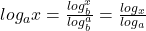
- Change of Base Formula: log_b(x) = log_a(x) / log_a(b)
- Logarithm of 1: log_b(1) = 0
- Logarithm of Base: log_b(b) = 1
- Negative Number Logarithm: log_b(x) is undefined for x ≤ 0
- Logarithm of Infinity: log_b(∞) = ∞
- Logarithm of Fraction: log_b(1/x) = -log_b(x)
- Logarithmic Identity: b^(log_b(x)) = x



Example  so we can write

Example  in logarithm form


Logarithms to the base 10 are known as common logarithms. When base is not mentioned it is taken as 10.
Characteristic – when the number is greater than 1 – the characteristic is one less from the number of digit in the left of the decimal point in the given number.

 ̅.41 = 3
When the number is less than 1 one more than the number of zero between the decimal point & the 1st significant digit of the number & it is negative.
0.518 = -1 0.0347 = etc.
Log table-








Conditions for Logarithms
For logax to be defined in real numbers, some conditions must be followed.
- The base a must be positive.
- The base a must not be equal to 1.
- The number x must be positive.
So log28 is defined, but log18 is not defined. Also, log of 0 and log of a negative number are not defined in real-number logarithms.
Common Logarithm
A logarithm with base 10 is called a common logarithm. It is written as log10x. In many school books and calculators, if the base is not written, log x usually means log10x.
Examples:
- log 10 = 1 because 101 = 10.
- log 100 = 2 because 102 = 100.
- log 1000 = 3 because 103 = 1000.
- log 1 = 0 because 100 = 1.
Natural Logarithm
A logarithm with base e is called a natural logarithm. It is written as ln x. The number e is an important mathematical constant whose approximate value is 2.71828.
Natural logarithms are widely used in higher mathematics, calculus, growth and decay problems, compound interest, and science. For basic aptitude, common logarithms and log rules are usually more important, but knowing ln helps when you move to advanced topics.
Basic Properties of Logarithms
| Property | Formula |
|---|---|
| Log of product | loga(xy) = logax + logay |
| Log of quotient | loga(x/y) = logax – logay |
| Power rule | loga(xn) = n logax |
| Log of 1 | loga1 = 0 |
| Log of base | logaa = 1 |
| Inverse rule | alogax = x |
| Change of base | logax = logbx / logba |
Product Rule of Logarithms
The logarithm of a product is equal to the sum of the logarithms of the factors.
loga(xy) = logax + logay
Example: log10(2 × 5) = log102 + log105.
Since 2 × 5 = 10, log1010 = 1. So log 2 + log 5 = 1.
Quotient Rule of Logarithms
The logarithm of a quotient is equal to the logarithm of the numerator minus the logarithm of the denominator.
loga(x/y) = logax – logay
Example: log(100/10) = log100 – log10.
log100 = 2 and log10 = 1.
So log(100/10) = 2 – 1 = 1.
Power Rule of Logarithms
The logarithm of a number raised to a power is equal to the power multiplied by the logarithm of the number.
loga(xn) = n logax
Example: log2(82) = 2 log28.
Since log28 = 3, the answer is 2 × 3 = 6.
Change of Base Formula
The change of base formula helps us calculate logarithms in a different base.
logax = logbx / logba
Example: log28 = log 8 / log 2.
Using common log values, log 8 = 0.9030 and log 2 = 0.3010.
log28 = 0.9030 / 0.3010 = 3.
Logarithm of 1 and Logarithm of Base
For any valid base a, loga1 = 0 because a0 = 1.
Example: log51 = 0.
For any valid base a, logaa = 1 because a1 = a.
Example: log77 = 1.
Logarithm of a Reciprocal
The logarithm of a reciprocal changes the sign.
loga(1/x) = -logax.
Example: log2(1/8) = -3 because 2-3 = 1/8.
Characteristic and Mantissa
In common logarithms, the value of a logarithm has two parts: characteristic and mantissa. The characteristic is the integer part. The mantissa is the decimal part.
Example: If log 48 = 1.6812, then 1 is the characteristic and 0.6812 is the mantissa.
For numbers greater than 1, the characteristic is one less than the number of digits before the decimal point.
| Number | Digits before decimal | Characteristic |
|---|---|---|
| 48 | 2 | 1 |
| 6185 | 4 | 3 |
| 756 | 3 | 2 |
| 92.5 | 2 | 1 |
For numbers less than 1, the characteristic is negative. It depends on the number of zeros after the decimal point before the first non-zero digit.
Example: For 0.518, there is no zero between decimal point and first significant digit, so characteristic is -1.
Example: For 0.0347, there is one zero between decimal point and first significant digit, so characteristic is -2.
Expanding Logarithmic Expressions
Expanding means writing one logarithm as a sum or difference of simpler logarithms.
Example: Expand loga(xy2).
loga(xy2) = logax + logay2.
= logax + 2logay.
Example: Expand loga(m/n).
loga(m/n) = logam – logan.
Combining Logarithmic Expressions
Combining means writing a sum or difference of logarithms as one logarithm.
Example: log x + log y = log(xy).
Example: log a – log b = log(a/b).
Example: 2log x = log(x2).
Example: log 2 + log 3 – log 6 = log(2 × 3 / 6) = log1 = 0.
Solving Simple Logarithmic Equations
To solve logarithmic equations, convert the logarithmic form into exponential form or use properties of logs. Always check the final answer because the number inside a logarithm must be positive.
Example 1
Solve log2x = 5.
Convert to exponential form.
x = 25 = 32.
Example 2
Solve log381 = x.
3x = 81.
81 = 34.
So x = 4.
Example 3
Solve log x = 2.
Base is 10 because no base is written.
x = 102 = 100.
Example 4
Solve log5(x + 1) = 2.
x + 1 = 52 = 25.
x = 24.
Important Values of Common Logarithms
| Value | Common logarithm |
|---|---|
| log 1 | 0 |
| log 2 | 0.3010 |
| log 3 | 0.4771 |
| log 5 | 0.6990 |
| log 10 | 1 |
These values are useful in many aptitude questions. For example, if log 2 is given as 0.3010, then log 8 can be found as log(23) = 3log2 = 0.9030.
Aptitude Examples on Logarithms
Example 1
If log 2 = 0.3010, find log 16.
16 = 24.
log16 = log(24) = 4log2 = 4 × 0.3010 = 1.2040.
Example 2
If log 2 = 0.3010 and log 3 = 0.4771, find log 6.
6 = 2 × 3.
log6 = log2 + log3 = 0.3010 + 0.4771 = 0.7781.
Example 3
If log 2 = 0.3010, find log(1/8).
1/8 = 2-3.
log(1/8) = log(2-3) = -3log2 = -0.9030.
Example 4
Find the number of digits in 2100, given log2 = 0.3010.
Number of digits in N = integer part of logN + 1.
log(2100) = 100log2 = 30.10.
Integer part is 30.
Number of digits = 30 + 1 = 31.
Example 5
Solve log(x + 5) + log(x – 5) = log144.
Use product rule.
log[(x + 5)(x – 5)] = log144.
x² – 25 = 144.
x² = 169.
x = 13 or -13. But x – 5 must be positive, so x must be greater than 5.
Therefore, x = 13.
Common Mistakes in Logarithms
- Writing log(a + b) = loga + logb. This is wrong.
- Forgetting that logarithms are defined only for positive numbers.
- Using base 10 automatically when a different base is written.
- Forgetting that loga1 = 0.
- Forgetting that logaa = 1.
- Not checking answers in logarithmic equations.
- Confusing log x2 with (log x)2. These are different expressions.
Practice Questions
- Convert 26 = 64 into logarithmic form.
- Convert log5125 = 3 into exponential form.
- Find log1010000.
- Find log327.
- Simplify log 2 + log 5.
- Simplify log 100 – log 10.
- If log2 = 0.3010, find log32.
- If log2 = 0.3010 and log3 = 0.4771, find log12.
- Solve log2x = 4.
- Solve log(x – 1) = 2.
- Find the number of digits in 520 if log5 = 0.6990.
- Simplify loga(x3y).
Answers to Practice Questions
- log264 = 6.
- 53 = 125.
- 4.
- 3.
- log10 = 1.
- log10 = 1.
- log32 = log(25) = 5log2 = 1.5050.
- log12 = log(3 × 4) = log3 + 2log2 = 0.4771 + 0.6020 = 1.0791.
- x = 16.
- x – 1 = 100, so x = 101.
- log(520) = 20 × 0.6990 = 13.98. Number of digits = 14.
- 3logax + logay.
Real Life Uses of Logarithms
Logarithms are used when numbers grow or shrink very quickly. In science, pH is measured using logarithms. Sound intensity is measured using a logarithmic scale. Earthquake magnitude also uses a logarithmic scale.
In finance, logarithms help in compound growth calculations. In computers, logarithms are used in algorithms, data structures, search problems, and information theory. In biology, population growth and bacterial growth can also be studied using exponential and logarithmic models.
The main idea is simple: logarithms help us handle very large or very small numbers in a manageable way.
Frequently Asked Questions
What is a logarithm?
A logarithm is the power to which a base must be raised to get a given number.
What is log101000?
log101000 = 3 because 103 = 1000.
What is common logarithm?
A logarithm with base 10 is called a common logarithm.
What is natural logarithm?
A logarithm with base e is called a natural logarithm. It is written as ln x.
What is loga1?
loga1 = 0 for any valid base a, because a0 = 1.
What is logaa?
logaa = 1 for any valid base a, because a1 = a.
Can we take log of a negative number?
In real-number mathematics, log of a negative number is not defined.
Can we take log of zero?
No. Logarithm of zero is not defined.
What is the product rule of logarithms?
The product rule says loga(xy) = logax + logay.
What is the change of base formula?
The change of base formula is logax = logbx / logba.
More Solved Examples on Logarithms
Example 1: Find log464
We need the power to which 4 must be raised to get 64.
41 = 4, 42 = 16, and 43 = 64.
So, log464 = 3.
Example 2: Find log981
We can write 81 as 92.
So, log981 = 2.
Example 3: Find log2(1/32)
We know 32 = 25.
So 1/32 = 2-5.
Therefore, log2(1/32) = -5.
Example 4: Simplify logam + logan – logap
Use product rule for addition and quotient rule for subtraction.
logam + logan = loga(mn).
Now subtract logap.
Answer = loga(mn/p).
Example 5: Solve log3(2x + 1) = 4
Convert into exponential form.
2x + 1 = 34.
2x + 1 = 81.
2x = 80.
x = 40.
Check: 2x + 1 = 81, which is positive, so the answer is valid.
Example 6: Solve log(x + 2) + log(x – 1) = log20
Use product rule.
log[(x + 2)(x – 1)] = log20.
(x + 2)(x – 1) = 20.
x² + x – 2 = 20.
x² + x – 22 = 0.
This gives x = (-1 ± √89)/2.
But x – 1 must be positive, so only the value greater than 1 is accepted.
Number of Digits Using Logarithms
Logarithms are very useful for finding the number of digits in a large power without calculating the full number. If N is a positive integer, then:
Number of digits in N = integer part of logN + 1.
Example: Find the number of digits in 320, given log3 = 0.4771.
log(320) = 20log3 = 20 × 0.4771 = 9.542.
Integer part is 9.
Number of digits = 9 + 1 = 10.
Example: Find the number of digits in 715, given log7 = 0.8451.
log(715) = 15 × 0.8451 = 12.6765.
Integer part is 12.
Number of digits = 12 + 1 = 13.
Logarithms and Scientific Notation
Scientific notation and logarithms are closely related because both use powers of 10. A number such as 500000 can be written as 5 × 10⁵. Its logarithm is close to 5 because the number lies between 105 and 106.
Similarly, a decimal number such as 0.004 lies between 10-3 and 10-2. Its common logarithm has a negative characteristic. This helps us estimate the size of very small numbers.
How to Study Logarithms Step by Step
- First learn exponents clearly because logarithms are based on powers.
- Practise converting exponential form into logarithmic form.
- Learn product, quotient, and power rules before attempting equations.
- Remember that log works only for positive numbers in real mathematics.
- Practise common log values such as log2, log3, log5, and log10.
- Use the change of base formula when the base is not convenient.
- Check answers after solving logarithmic equations.
Quick Revision Table
| Question type | Method |
|---|---|
| Convert am = x | Write logax = m |
| Convert logax = m | Write am = x |
| log of product | Use addition |
| log of quotient | Use subtraction |
| log of power | Bring power in front |
| base not suitable | Use change of base formula |
| log equation | Convert to exponential form or combine logs |
| number of digits | Use integer part of common log plus 1 |
One-Minute Recap
A logarithm is simply a power. If 26 = 64, then log264 = 6. Product becomes addition in logarithms, quotient becomes subtraction, and powers come in front as multiplication.
Common logarithm uses base 10. Natural logarithm uses base e. For real numbers, the number inside a logarithm must always be positive, and the base must be positive but not equal to 1.
Conclusion
Logarithms are the reverse way of thinking about exponents. If exponents tell us the result of repeated multiplication, logarithms tell us the power used to get that result.
To learn logarithms well, remember the basic conversion between exponential and logarithmic form, practise the product, quotient, and power rules, and always check the base and domain of the logarithm.