
JButton in Java is defined in javax.swing package .
JButton in child of javax.swing.AbstractButton.
public class JButtonextends AbstractButton
implements Accessible
To create instance of JButton many constructors are provided.
JButton Consturctor
| Sr No | Constructors and Description |
|---|---|
| 1 | JButton() Creates a button with no set text or icon. |
| 2 | JButton(Action a) Creates a button where properties are taken from the Action supplied. |
| 3 | JButton(Icon icon) Creates a button with an icon. |
| 4 | JButton(String text) Creates a button with text. |
| 5 | JButton(String text, Icon icon) Creates a button with initial text and an icon. |
Let us see all constructors one by one.
Commonly used AbstractButton methods
| Sr No | Method and Description |
|---|---|
| 1 | String getText() get the text of Button |
| 2 | void setText(String text) Sets the button’s text. |
| 3 | Icon getIcon() Get the icon of Button |
| 4 | void setIcon(Icon defaultIcon) Set the icon on button |
| 5 | void addActionListener(ActionListener l) Add an action listener to a button |
| 6 | void setEnabled(boolean b) Enable or disable the button based on boolean argument |
| 7 | void setMnemonic(int mnemonic) Set the keyboard Mnemonic for button |
Java JButton Examples
How to add Icon to JButton in Java
import java.awt.Container;
import javax.swing.Icon;
import javax.swing.ImageIcon;
import javax.swing.JButton;
import javax.swing.JFrame;

public class JButtonExamle1 extends JFrame {

    Container container;
    JButton b1, b2, b3, b4;

    public JButtonExamle1() {

        container = this.getContentPane();
        container.setLayout(null);

        //default constructor
        b1 = new JButton();
        b1.setBounds(20, 40, 100, 40);
        container.add(b1);
        //constructor with string argument
        b2 = new JButton("Login");
        b2.setBounds(140, 40, 100, 40);
        container.add(b2);

        ImageIcon ii = new ImageIcon("d://icons/Java-icon.png");
        //constructor with image argument
        b2 = new JButton(ii);
        b2.setBounds(260, 40, 100, 40);
        container.add(b2);

        ImageIcon i1 = new ImageIcon("d://icons/loud.png");
        //constructor with string and image
        b3 = new JButton("Loud", i1);
        b3.setBounds(380, 40, 100, 40);
        container.add(b3);
    }

    public static void main(String[] args) {
        JButtonExamle1 frame = new JButtonExamle1();
        frame.setTitle("Button Example");
        frame.setVisible(true);
        frame.setBounds(250, 100, 520, 300);
        frame.setDefaultCloseOperation(JFrame.EXIT_ON_CLOSE);
        frame.setResizable(false);
    }

}
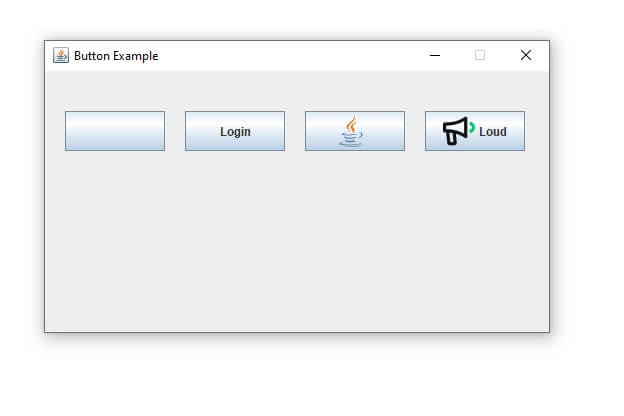
JButton Click and ActionListner Example
import java.awt.Container;
import java.awt.event.ActionEvent;
import java.awt.event.ActionListener;
import javax.swing.ImageIcon;
import javax.swing.JButton;
import javax.swing.JFrame;
import javax.swing.JOptionPane;

public class JButtonExamle2 extends JFrame implements ActionListener {

    Container container;
    JButton login;

    public JButtonExamle2() {

        container = this.getContentPane();
        container.setLayout(null);

        ImageIcon image = new ImageIcon("d://icons/login.png");
        login = new JButton("Login ", image);
        login.setBounds(140, 100, 150, 40);
        container.add(login);
        login.addActionListener(this);
    }

    @Override
    public void actionPerformed(ActionEvent e) {
        if (e.getSource() == login) {
            JOptionPane.showMessageDialog(null, "You Clicked Login Button");
        }
    }

    public static void main(String[] args) {
        JButtonExamle2 frame = new JButtonExamle2();
        frame.setTitle("Button Example");
        frame.setVisible(true);
        frame.setBounds(250, 100, 520, 300);
        frame.setDefaultCloseOperation(JFrame.EXIT_ON_CLOSE);
        frame.setResizable(false);
    }

}

ActionCommand and Mnemonic Example in JButton
import java.awt.Container;
import java.awt.event.ActionEvent;
import java.awt.event.ActionListener;
import java.awt.event.KeyEvent;
import javax.swing.ImageIcon;
import javax.swing.JButton;
import javax.swing.JFrame;
import javax.swing.JLabel;

public class JButtonExamle3 extends JFrame implements ActionListener {

    Container container;
    JButton b1, b2;
    ImageIcon imageLock, imageUnLock;
    JLabel label;

    public JButtonExamle3() {

        container = this.getContentPane();
        container.setLayout(null);

        b1 = new JButton("Lock ");
        b1.setBounds(140, 170, 200, 40);
        container.add(b1);
        b1.setActionCommand("lock");
        b1.setMnemonic(KeyEvent.VK_D);
        b1.addActionListener(this);
        label = new JLabel("Alt +d to lock and unlock button");
        label.setBounds(140, 230, 200, 20);
        container.add(label);

        imageLock = new ImageIcon("d://icons/lock.png");
        imageUnLock = new ImageIcon("d://icons/unlock.png");
        b2 = new JButton(imageUnLock);
        b2.setBounds(140, 20, 200, 100);
        container.add(b2);
    }

    @Override
    public void actionPerformed(ActionEvent e) {
        if (e.getActionCommand().equals("lock")) {
            b2.setEnabled(false);
            b2.setIcon(imageLock);
            b1.setActionCommand("Unlock");
            b1.setText("Unlock");
        } else {
            b2.setEnabled(true);
            b2.setIcon(imageUnLock);
            b1.setActionCommand("lock");
            b1.setText("Lock");
        }
    }

    public static void main(String[] args) {
        JButtonExamle3 frame = new JButtonExamle3();
        frame.setTitle("Button Example");
        frame.setVisible(true);
        frame.setBounds(250, 100, 520, 300);
        frame.setDefaultCloseOperation(JFrame.EXIT_ON_CLOSE);
        frame.setResizable(false);
    }

}
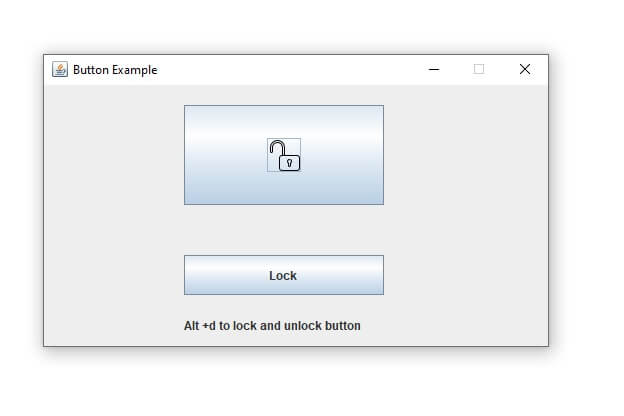
Image source https://freeicons.io/