
Geometric Progression, also called Geometrical Progression or GP, is an important topic in sequences and series. It is used in mathematics, aptitude, compound interest, population growth, depreciation, finance, science, computer algorithms, and many real-life situations where a quantity is repeatedly multiplied by the same number.
A sequence is called a geometric progression when each term is obtained by multiplying the previous term by a fixed non-zero number. This fixed number is called the common ratio. For example, 2, 6, 18, 54, … is a GP because every term is obtained by multiplying the previous term by 3.
This lesson explains Geometric Progression in simple language. The existing formulas and images in this post are kept, and new explanations, formula tables, solved examples, exam-style questions, and FAQs are added to make the topic complete.
What Is Geometric Progression?
A geometric progression is a sequence of numbers in which the ratio of any term to its previous term remains constant. This constant ratio is called the common ratio.
Example: 3, 6, 12, 24, 48, …
Here each term is obtained by multiplying the previous term by 2.
6/3 = 2, 12/6 = 2, 24/12 = 2.
So the common ratio is 2, and the sequence is a GP.
Common Ratio
The common ratio is denoted by r. It is found by dividing any term by the term just before it.
r = second term / first term = third term / second term = fourth term / third term.
Example: Find the common ratio of 5, 15, 45, 135.
r = 15/5 = 3.
Also, 45/15 = 3 and 135/45 = 3.
So the common ratio is 3.
Existing GP Formula
A progression of numbers in which every term bears a constant ratio with its proceeding term is called a Geometrical Progression(G.P.)
The constant ratio is called common ratio.


General Form of a GP
If the first term is a and the common ratio is r, then the GP is written as:
a, ar, ar², ar³, ar⁴, …
Here:
- a is the first term.
- r is the common ratio.
- ar is the second term.
- ar² is the third term.
- ar³ is the fourth term.
Example: If a = 2 and r = 3, then the GP is 2, 6, 18, 54, 162, …
Nth Term of a GP
The nth term of a GP is used to find any term directly without writing all previous terms.
Tn = arn-1
Here a is the first term, r is the common ratio, and n is the term number.
Example: Find the 6th term of 2, 6, 18, …
Here a = 2, r = 3, and n = 6.
T6 = 2 × 35 = 2 × 243 = 486.
So the 6th term is 486.
How to Check Whether a Sequence Is GP
To check whether a sequence is a GP, divide every term by the previous term. If the ratio is the same each time, the sequence is a GP.
Example: Check whether 4, 12, 36, 108 is a GP.
12/4 = 3.
36/12 = 3.
108/36 = 3.
The ratio is same, so it is a GP.
Example: Check whether 2, 4, 8, 18 is a GP.
4/2 = 2.
8/4 = 2.
18/8 = 2.25.
The ratio is not same, so it is not a GP.
Finite GP and Infinite GP
A finite GP has a fixed number of terms. Example: 2, 4, 8, 16, 32 is a finite GP with 5 terms.
An infinite GP continues without ending. Example: 1, 1/2, 1/4, 1/8, … is an infinite GP.
Finite GP is common in school questions. Infinite GP is important in higher mathematics when the common ratio lies between -1 and 1.
Sum of First n Terms of a GP
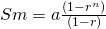
The sum of the first n terms of a GP is called a geometric series. If a is the first term and r is the common ratio, then:
Sn = a(rn – 1)/(r – 1), when r > 1.
It can also be written as:
Sn = a(1 – rn)/(1 – r), when r < 1.
Both formulas are equivalent. Choose the form that keeps the calculation easy.
Example: Find the sum of first 5 terms of 3, 6, 12, …
Here a = 3, r = 2, n = 5.
S5 = 3(25 – 1)/(2 – 1).
= 3(32 – 1) = 3 × 31 = 93.
Sum of Infinite GP
An infinite GP has a finite sum only when the common ratio r lies between -1 and 1.
If |r| < 1, then the sum of infinite GP is:
S∞ = a/(1 – r)
Example: Find the sum of 1 + 1/2 + 1/4 + 1/8 + …
Here a = 1 and r = 1/2.
S∞ = 1/(1 – 1/2) = 1/(1/2) = 2.
So the sum is 2.
GP with Positive, Negative, and Fractional Common Ratio
If r is positive and greater than 1, the terms increase. Example: 2, 4, 8, 16, …
If r is positive and between 0 and 1, the terms decrease. Example: 100, 50, 25, 12.5, …
If r is negative, the signs of terms alternate. Example: 3, -6, 12, -24, … Here r = -2.
If r is a fraction, the sequence may become smaller. Example: 81, 27, 9, 3, 1, … Here r = 1/3.
Arithmetic Progression and Geometric Progression Difference
| Point | Arithmetic Progression | Geometric Progression |
|---|---|---|
| Short form | AP | GP |
| Pattern | Same difference | Same ratio |
| Operation | Add or subtract same number | Multiply or divide by same number |
| Example | 2, 5, 8, 11 | 2, 6, 18, 54 |
| Common value | Common difference | Common ratio |
Finding Missing Terms in GP
To find missing terms in a GP, use the common ratio.
Example: Find x in 4, x, 36.
For three terms in GP, middle term squared equals product of first and third terms.
x² = 4 × 36 = 144.
x = 12 or -12.
So the missing term can be 12 or -12, depending on the sequence pattern.
Example: Find the missing term in 5, 15, x, 135.
Common ratio r = 15/5 = 3.
So x = 15 × 3 = 45.
Geometric Mean
If a, b, c are in GP, then b is called the geometric mean of a and c.
b² = ac.
So b = √(ac).
Example: Find the geometric mean of 4 and 36.
Geometric mean = √(4 × 36) = √144 = 12.
Product of Terms in GP
If there are three terms in GP, we often write them as a/r, a, ar. This form is useful because the common ratio is clear and the middle term is simple.
If there are five terms in GP, we can write them as a/r², a/r, a, ar, ar².
These forms are useful in aptitude questions where product or sum of terms is given.
Worked Examples
Example 1
Find the common ratio of 7, 21, 63, 189.
r = 21/7 = 3.
So the common ratio is 3.
Example 2
Find the 8th term of the GP 1, 3, 9, …
Here a = 1, r = 3, n = 8.
T8 = 1 × 37 = 2187.
Example 3
Find the 5th term of 81, 27, 9, …
Here a = 81 and r = 1/3.
T5 = 81 × (1/3)4 = 81/81 = 1.
Example 4
Find the sum of first 4 terms of 2, 6, 18, …
The first four terms are 2, 6, 18, 54.
Sum = 2 + 6 + 18 + 54 = 80.
Example 5
Find the sum of first 6 terms of a GP whose first term is 5 and common ratio is 2.
S6 = 5(26 – 1)/(2 – 1).
= 5(64 – 1) = 315.
Example 6
Find the sum of infinite GP 6 + 3 + 3/2 + 3/4 + …
Here a = 6 and r = 1/2.
S∞ = 6/(1 – 1/2) = 12.
Example 7
Three numbers are in GP. Their product is 216 and the middle term is 6. Find one possible set.
Let the numbers be 6/r, 6, 6r.
Their product is 216 for any non-zero r because (6/r) × 6 × (6r) = 216.
If r = 2, the numbers are 3, 6, 12.
Real Life Uses of GP
GP is used when a quantity grows or decreases by the same ratio again and again. Compound interest is a common example. If money increases by a fixed percentage every year, it forms a geometric pattern.
Population growth may also follow a geometric pattern for some time. If a population doubles every fixed period, then the sequence becomes P, 2P, 4P, 8P, and so on.
Depreciation also uses GP. If the value of a machine decreases by 10 percent every year, then each year’s value is multiplied by 0.9.
GP is also used in computer science, physics, biology, finance, and measurement scales.
Common Mistakes in GP
- Confusing common difference with common ratio.
- Using AP formula in GP questions.
- Forgetting that Tn = arn-1, not arn.
- Using the infinite sum formula when |r| is not less than 1.
- Ignoring negative common ratio.
- Making sign mistakes when r is negative.
Practice Questions
- Find the common ratio of 2, 10, 50, 250.
- Find the 6th term of 3, 6, 12, …
- Find the 7th term of 5, 15, 45, …
- Find the sum of first 5 terms of 1, 2, 4, …
- Find the sum of first 4 terms of 4, 12, 36, …
- Find the missing term in 9, x, 81.
- Find the geometric mean of 16 and 64.
- Find the sum of infinite GP 8 + 4 + 2 + 1 + …
- Check whether 2, 6, 18, 54 is a GP.
- Check whether 3, 9, 18, 54 is a GP.
Answers to Practice Questions
- Common ratio = 5.
- 6th term = 96.
- 7th term = 3645.
- Sum = 31.
- Sum = 160.
- x = 27 or -27.
- Geometric mean = 32.
- Infinite sum = 16.
- Yes, common ratio is 3.
- No, the ratio is not same throughout.
Frequently Asked Questions
What is a geometric progression?
A geometric progression is a sequence in which each term is obtained by multiplying the previous term by a fixed number.
What is common ratio?
Common ratio is the fixed number by which each term is multiplied to get the next term.
What is the formula for nth term of GP?
The nth term of GP is Tn = arn-1.
What is the sum formula of GP?
The sum of first n terms is Sn = a(rn – 1)/(r – 1), when r is not equal to 1.
What is the sum of infinite GP?
If |r| < 1, then the sum of infinite GP is S∞ = a/(1 – r).
What is geometric mean?
The geometric mean of two positive numbers a and b is √(ab).
What is the difference between AP and GP?
AP has a common difference, while GP has a common ratio.
Can common ratio be negative?
Yes. If the common ratio is negative, the signs of terms alternate.
Derivation of Nth Term Formula
Let the first term of a GP be a and the common ratio be r.
First term = a.
Second term = a × r = ar.
Third term = ar × r = ar².
Fourth term = ar² × r = ar³.
From this pattern, the power of r is always one less than the term number. Therefore, the nth term is:
Tn = arn-1.
This formula is useful because we do not need to write all previous terms. We can directly find the required term.
Derivation Idea of Sum of GP
Let the sum of first n terms be:
Sn = a + ar + ar² + ar³ + … + arn-1.
Multiply both sides by r:
rSn = ar + ar² + ar³ + … + arn.
Now subtract the first equation from the second equation. Most middle terms cancel.
rSn – Sn = arn – a.
Sn(r – 1) = a(rn – 1).
So, Sn = a(rn – 1)/(r – 1), when r is not equal to 1.
If r is less than 1, the same formula is often written as Sn = a(1 – rn)/(1 – r) to keep values positive and easy.
Special Case When r = 1
If the common ratio is 1, every term of the GP is the same.
Example: 5, 5, 5, 5, 5 is a GP with r = 1.
In this case, the sum of n terms is simply:
Sn = na.
Example: Find the sum of first 8 terms of 7, 7, 7, …
Here a = 7 and n = 8.
Sum = 8 × 7 = 56.
More Exam Examples
Example 1: Find first term
The 5th term of a GP is 48 and common ratio is 2. Find the first term.
T5 = ar4.
48 = a × 24.
48 = 16a.
a = 3.
Example 2: Find common ratio
The first term of a GP is 4 and the fourth term is 108. Find the common ratio.
T4 = ar3.
108 = 4r3.
r3 = 27.
r = 3.
Example 3: Find number of terms
In the GP 3, 6, 12, …, the last term is 192. Find the number of terms.
Here a = 3, r = 2, and Tn = 192.
192 = 3 × 2n-1.
64 = 2n-1.
64 = 26.
So n – 1 = 6 and n = 7.
Example 4: Find sum using formula
Find the sum of first 5 terms of the GP 2, 10, 50, …
Here a = 2, r = 5, n = 5.
S5 = 2(55 – 1)/(5 – 1).
= 2(3125 – 1)/4.
= 2 × 3124 / 4 = 1562.
Example 5: Infinite GP
Find the sum of 12 + 6 + 3 + 3/2 + …
Here a = 12 and r = 1/2.
Since |r| < 1, infinite sum exists.
S∞ = 12/(1 – 1/2) = 24.
Word Problems Based on GP
Problem 1
A ball falls from a height of 80 m and rebounds to half of the previous height each time. Write the first four rebound heights.
First rebound = 40 m.
Second rebound = 20 m.
Third rebound = 10 m.
Fourth rebound = 5 m.
The rebound heights form a GP: 40, 20, 10, 5 with common ratio 1/2.
Problem 2
A bacteria culture doubles every hour. If there are 100 bacteria now, how many will be there after 5 hours?
The pattern is 100, 200, 400, 800, …
After 5 hours, multiply by 2 five times.
Number = 100 × 25 = 3200.
Problem 3
A machine loses 20 percent of its value every year. If its present value is 50000 rupees, write the value after 3 years.
Every year the value becomes 80 percent of the previous value, so r = 0.8.
Value after 3 years = 50000 × (0.8)3.
= 50000 × 0.512 = 25600 rupees.
GP in Compound Interest
Compound interest follows a geometric pattern because the amount is multiplied by the same growth factor after each period.
If principal is P and rate is r percent per year, then the amount after n years is:
A = P(1 + r/100)n.
Example: If 10000 rupees grows at 10 percent compound interest per year, the amounts are 10000, 11000, 12100, 13310, and so on. The common ratio is 1.1.
How to Choose the Right GP Formula
| Need | Use formula |
|---|---|
| Find any term | Tn = arn-1 |
| Find sum of first n terms | Sn formula |
| Find infinite sum | S∞ = a/(1 – r), only if |r| < 1 |
| Find common ratio | r = term / previous term |
| Find geometric mean | √(ab) |
One-Minute Revision
GP is based on multiplication by a fixed ratio. The first term is a and the common ratio is r. The general form is a, ar, ar², ar³, and so on. The nth term is arn-1.
For finite sums, use the GP sum formula. For infinite sums, first check whether |r| is less than 1. If it is not less than 1, the infinite sum does not have a finite value.
The most common exam tasks are finding the common ratio, finding nth term, finding sum, inserting missing terms, identifying GP, and solving simple word problems based on repeated growth or repeated decrease.
More Quick Examples
Example: Find the next two terms of 6, 18, 54, …
The common ratio is 18/6 = 3. So the next terms are 54 × 3 = 162 and 162 × 3 = 486.
Example: Find the common ratio of 64, 32, 16, 8.
r = 32/64 = 1/2. So the common ratio is 1/2.
Example: Find the 4th term of a GP whose first term is 10 and common ratio is -2.
T4 = ar3 = 10 × (-2)3 = -80.
Example: Insert one geometric mean between 9 and 81.
Geometric mean = √(9 × 81) = √729 = 27.
Example: Check whether 5, 10, 25, 50 is a GP.
10/5 = 2, but 25/10 = 2.5. The ratio is not same, so it is not a GP.
These examples show that GP questions are mostly based on one idea: the same ratio must connect consecutive terms. Once the ratio is clear, the rest of the question becomes formula-based.
Conclusion
Geometric Progression is a sequence where each term is connected by a common ratio. Once you know the first term and common ratio, you can find any term and sum of terms easily.
Practise identifying the common ratio, using the nth term formula, finding sums, and solving missing-term questions. These are the most important skills for GP problems.